|
Healthy Living...
|
||||||||||||



It is the Principles of any system that holds the tactics, techniques and applications together. Without a full understanding of these subtle concepts, a massage method becomes a group of pre-defined movements, void of any true continuity. Esomassage has a well defined philosophy that binds the resulting techniques to create a remarkably well formed healing art."
Esomassage is a new form of massage, born through the union of Tai Chi and Martial Arts. The principles of structure, balance, movement, grounding and force vector application, the foundation of tai chi, have long been known as the fundamentals most sought after for massage practitioners worldwide. Many massage schools include some class time to introduce tai chi as a means of learning how to use the body in ways that will prevent fatigue and injury to the therapist while assuring the client receives the best treatment possible. Few therapists truly realize the importance of proper structure and the principles of movement and therefore rarely every seek the additional training needed from a qualified instructor.
Imagine feeling energized rather than fatigued at the end of six to eight massage day. Esomassage starts with learning and understanding the need to demonstrate the skills necessary to affect more by doing less, through the proper application of these time honored principles, then blends the hand techniques of martial arts to manipulate, distribute and penetrate based on the intent of the session. These hand techniques will allow the therapist to be more productive, saving time and energy while giving the client positive results in ways that will astound them.
The true essence of Esomassage is not to learn a set of pre-defined movements, nor to become proficient at pain management or relaxation, although these will manifest during the course of continual practice. The primary goal of Esomassage is to become more aware of the natural laws, which govern change. Not just change in the body as it affects physical, structural movement, but rather the principles of change and movement that govern every aspect of our lives and the world around us. The exercises and forms of the practice simply provide us with an opportunity to explore that process of discovery.
Structural
Principles
Correct structural alignment with gravity, and proper grounding to the earth, provides the basis for all Tai Chi, Massage and Qigong practices. Through fundamental standing postures, breathing exercises, intent and relaxing, a deep sense of rooting and connection with the earth is developed. Simple standing in prescribed postures develops correct structural alignment, and a lower center of gravity, which greatly aids in the flow of Qi to the client plus allows the therapist to work for hours without fatigue.
There are several hundred types of massage practice around the world, each with their own goal and repertoire of specific techniques designed to reach that goal. The goal can be for stress reduction, healing specific conditions in oneself or others, postural corrections, increased energy and others. The prerequisites to all higher forms of massage styles and systems strive for:
 |
postural alignment with gravity, | |
|
appropriate breathing, | |
|
a concentrated intent | |
|
and relaxed, open joints are the qigong studies. |
Both in the therapist and the client!
In our clinic we concentrate on these four areas with our clients. When these four components are incorporated into our level of awareness, Qi (Chee) will automatically flow. An added benefit is that postural alignment with gravity, appropriate breathing, a concentrated intent and relaxed, open joints affect so many aspects of our lives and create changes in a very holistic way.
1)
Posture
Postural alignment with gravity is so important. Gravity is a force that we must address every day of our lives and there is no escaping it. As we become more sensitive to the force of gravity and its relationship to movement, everything we do requires less energy; there is less ware and tear on our bodies, therefore we increase our longevity potential. There are too many massage therapists who quit after two years because they feel that the practice of doing massage is too hard on their body. This would not have happened if they had proper training in Tai Chi Principles. Esomassage gives you the proper training!
2)
Breathing
Breathing should remain natural and relaxed,
utilizing the diaphragm to pull oxygen into the lungs. This frees the chest
muscles and allows them to be used for the work of massage. Breathing with the chest forces
the practitioner to hold their breath during strenuous activity. Proper
breathing helps to relax you. It allows more oxygen intake. You do not tire as
quick. It removes more waste, allowing the muscles to work longer without
fatigue.
3)
Intent
Intent is considered to be the most important component of Martial Arts and tai chi; for the massage therapist, it is invaluable! It has been stated that with proper intent, anything is possible and without proper intent, nothing can happen. So what is it about intent that makes it so powerful? Intent drives the brain. Every cell in our body responds to our intent. Changing our intent can change even the systematic firing order of muscles during something as simple as walking. Clients with “frozen shoulder” can expand their range of motion simply by changing their intent.
Imagine pressing on two large bags; one filled with cotton, the other filled with sand. Knowing which bag is filled with which substance will determine the amount of pressure you apply to the bag. What is your intent when you first place your hand on a client; cotton or sand? Intent makes a huge difference
4)
Let go and relax
Force is never used in the cultivation of the fundamental principles of Qigong and tai chi; it is a journey of letting go! It’s learning how to let go and what to let go of. The same is true in life and equally true in massage therapy. Energy is neutral; it’s neither positive nor negative until we decide with our intent how we plan to use it. Developing the ability to recognize what we need to let go of in our physical body, prepares us for the more complicated task of letting go in other areas of our life. Holding on to the past requires tremendous energy. The more energy we use to keep the past alive, the less we have to maintain a healthy, productive life.
Our first objective is to let go of all constricted muscles that are not necessary for our posture to be in balanced alignment with the force of gravity.
It almost seems as though it’s human nature to resist change; or is it just a learned aspect of our culture? There is always more energy required to resist than to allow, more to hold on rather than to let go. To let go is to relax!
Releasing
resistance and allowing change…
Our goal is to let go of opposition, passive or active and make it possible through lack of action for something to happen that will cause something to pass from one state to another. We are constantly resisting that which is natural. We have a difficult time allowing events to take their natural course.
Why do we hold on to so much? Is it due to our upbringing as children? How often do we hear children tell someone “it’s mine”? In our culture, to let go of something is to lose something. No one wants to be without. We get programmed at a very early age to hold on to things. Some of us even become pack rats; hoarding everything we get our hands on.
It’s not only things that we cling to. So much of our mind, body and spirit is cluttered with stuff that prevent us from becoming the person we want to be. We cling to old belief systems that were never ours to begin with. The people around us who were in authority over us attached these belief systems to us. It could have been our parents, teachers, grandparents, neighbors, books we read, or even TV that convinced us certain beliefs were important enough; so we adopted them as our own.
When we are young children, we believe everything adults tell us. We are hungry for information. “What’s that, Mommy”? “Why”? “Why not”? We have no definitions for the world around us. As children, we don’t choose what to believe. What things mean is given to us. Much of what we hold as being very important to us is actually not important to us at all. It was important to the person who uploaded it to you in the first place. The country, state, city, family, financial status, gender, religion all had a powerful influence on what our “uploaders” valued and what they believed. Maybe you were told: "Honesty’s the best policy." "It’s just a little white lie." "Do as I say, not as I do." "Tell me the truth and I won’t punish you."
By learning the basic principles of Qigong, we prepare ourselves for the more difficult task of letting go of the multi-dimensional layers of “stuff” constricting our personal growth and spiritual development.
Static
external, dynamic internal
Proper Grounding and Hugging the Tree is about four thousand years old, and has been used for everything from building core strength to self-healing, lowering blood pressure, increasing respiration and alertness, reducing stress and pain, plus improving health and overall energy. The result is a high level of internal motion within the body that drives your Qi to move through its energy channels as the blood surges through your veins and arteries. Eventually you expand beyond your normal limits of endurance to a highly energized state of alert tranquility.
Grounding Exercise
Stand
in relaxed position with the feet placed directly under your hips, knees
slightly bent, ankles relaxed and the armpits open. Press the tip of the tongue
against the roof of the mouth. This connects the energy circuit of the governing
(back) channel with the energy circuit of the functional (front) channel.
Breathe by pulling the diaphragm down toward navel as you inhale and allowing
the diaphragm to back up toward the chest as you exhale. Imagine a weight
hanging between your legs, attached to your coccyx by a cord. As the weight
pulls your coccyx toward the floor, allow your sacrum to relax and sink down and
forward with it. Relax the ankles. Relax the knees. Relax the waist. Imagine
there is a cord attached to the top of the head that is gently lifting your
head, allowing it to float above your shoulders. Fix your gaze on the horizon to
infinity. After fulfilling the above requirements, imagine that everything inside your body is
comprised of nothing but thick water molecules and that the skin is made of
rubber. Feel the water molecules pressing against the skin as gravity begins to
pull the water molecules down through the body, toward the floor. As the water
molecules are pulled lower and lower, you can feel the arms and chest begin to
swell. The fingers feel as though they are swelling to an enormous size.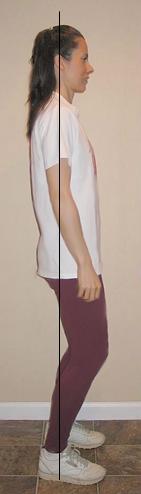
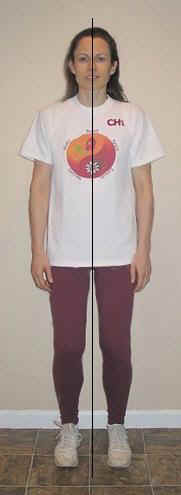
As gravity pulls the water molecules even lower, the thighs become thick and heavy. The molecules flow deeper into your legs and feet until your feet feel as though they are going to burst out of your shoes. Feel the feet spread. Feel the toes spread. Your body now feels like a pyramid, heavy at the floor and light at the top.
Continue to breathe deep into the lower abdomen. Allow your attention to move to your feet and notice where the primary weight is located. It should be in the middle of each foot. If it's not, adjust the position of your pelvis until it is. An imaginary plumb line should travel through the crown point of your head, to a point just behind your ear, through your shoulder, hip, perineum and ankle. Don't forget to be aware of the imaginary weight pulling down at your coccyx and the cord pull upward on your head. Relax the waist and allow the coccyx to sink down andforward.
Once you have accomplished the feeling of being grounded well into the earth or floor, imagine that the floor is pushing up against your feet, trying to up-root you. This is one of the most important aspects of the exercise. The more relaxed and grounded you become, the harder the floor pushes up against your feet. Use your imagination to keep the floor from pushing you upward. Hold the floor down. Do not allow the floor to push you up. Your feet will now feel as though they are glued to the floor.
After about 10 minutes, your feet will feel energized and your hands will become warm. Stand in this position for 10 to 20 minutes. Be sure to keep the knees bent.
Hugging
the Tree
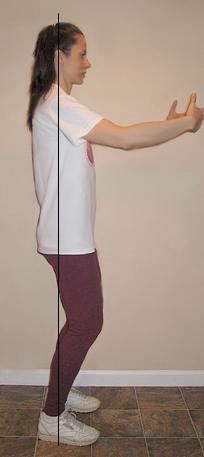
After acquiring the position of grounding, we move to the next posture called “hugging the tree”. This posture allows the energy around us to flow into the body and travel through the energy channels called meridians to all parts of the body. This energy, called “chi” in Chinese will begin to manifest itself as heat and electromagnetic pulsation of attraction and propulsion. This manifestation is known as “jing”.
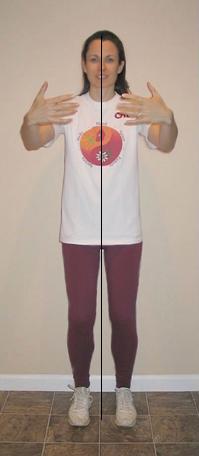
Stand in the same position as in the grounding posture. Allow the arms to float up and away from you until they reach the level of your chest. Form a large circle with your arms in front of you, your fingers pointing toward each other about a palms width apart. Imagine you are holding a huge beach ball in your arms. As you hold this static position, go through all the checkpoints of the grounding posture to assure you are still maintaining the proper alignment with the force of gravity. Let go of all unnecessary use of muscles not required to hold the arms in the circle in front of your chest. It is important that every joint remain open and free of tension. Keep the armpits open and the shoulders down and relaxed.
After a few minutes, the hands will begin to feel warm and tingly. The feet will feel warm, even hot. This is your assurance that your posture is correct and the chi is circulating throughout the body. The more relaxed and open the joints and muscles become, the more pronounced the feeling of the chi flow will be.
 |
 |
Understanding
the health benefits of Qi and its effect on the health of the organism.
Imagine that you have a beautiful, crystal clear stream flowing through your back yard. One morning you wake up to find that your back yard is flooded. Within a short period of time, you notice mosquitoes breeding, algae are growing in the water and bacteria begin to flourish. The stagnant water becomes a breeding ground for many organisms.
One solution would be to spray to kill the mosquitoes, apply chemicals to the water to kill the algae and bacteria. It’s obvious that this would only be treating the symptom of the problem and not the cause. The mosquitoes are breeding in an environment well suited for that purpose. A better solution would be to find the cause of the stagnant water that is supporting the life and growth of the undesirable organisms. If there is static flow, there is always a blockage. Checking down stream, we will find something blocking the flow of water in the stream causing the water to backup and therefore, creating a stagnant pond in our otherwise pristine environment. The dam can be removed either by physical manipulation of the blockage (removing the debris), or by applying a more forceful flow of water (to wash the debris away).
Qigong attempts to balance the flow of energy by using one of these two methods. Tree standing Qigong is designed to balance the flow by creating a steady flow of energy to open the pathways such that adequate flow can be achieved through a relaxed posture in alignment with the force of gravity. Each joint in the body has the potential to either diminish the flow (joint constriction), or to augment the flow (joint openness). The primary structural components in human anatomy are bones and ligaments. These structural components keep us standing erect with virtually no expenditure of energy. Muscles, aside from some of the deep stabilizing muscles, are designed to move joints and are not needed for standing.
A
deeper look into Tree Standing
All muscles of the body are comprised of both fast twitch fibers and slow twitch fibers. The muscles used for most movement are comprised of at least 50% fast and 50% slow twitch fibers. The muscles that are primarily used for quick action have more fast twitch than slow twitch fibers. Fast twitch fibers contract at about 1/20 of a second and are designed to reset their length quickly but become fatigued faster and therefore endurance is minimal. The deep stabilizing muscles, also known as the core muscles, contract at about 1/10 of a second and are designed for endurance. Aside from maintaining proper alignment with the force of gravity, our goal is to develop a strong core by letting go of the fast twitch muscle fibers through relaxation and to allow the slow twitch fibers dominate control of standing. This is something we almost never do in our fast-paced lifestyle. It takes tremendous control to let go of what has become our standard use of muscle tension.
As an example, the two muscles of the calves, the gastrocnemius and the soleus are comprised of 50% and 67% slow twitch fibers respectively. The gastrocnemius attaches through the Achilles tendon and crosses the knee. It is used for running and quick movement. The soleus attaches through the Achilles tendon, but does not cross the knee and is used as a postural stabilizing muscle. By bending the knees when standing, we disengage the gastrocnemius and allow the soleus to do most of the work of holding our posture while simultaneously creating a more open and relaxed joint at the knees.
Movement
Shake the Tree (Bouncing)
In China, this technique is called “shaking the tree”. Bouncing is one of the most beneficial qigong exercises available and can be done by virtually anyone with awesome results.
Stand in relaxed position with the feet pointed straight ahead and placed directly under your hips. Briefly allow the entire body to collapse under the weight of gravity and instantly catch yourself before the body has a chance to drop no more than one inch. This will create a small jolt to reverberate throughout the body from the feet to the top of the head. Repeat using a steady rhythm of about one bounce every second or a little faster. As you “catch” yourself each time you “let go”, the tendons of the muscles in the legs will abruptly contract causing the body to quickly bounce back up to the starting position. The contraction is so quick and slight that there is very little expenditure of energy. Bouncing can be done for 15 to 30 minutes without tiring.
Be sure to notice if you are just lowering and raising the body rather than bouncing. If you feel the thigh muscles tiring or burning, you are not allowing yourself to let go in such a way to allow the body to bounce back into position.
During the bouncing exercise there are three objectives to keep your attention on:
-
The sacrum must be relaxed enough so that you can feel it swinging back and forth with each bounce
-
The shoulders remain soft enough so that you can feel them bouncing up and down
-
The neck should be relaxed enough so that the head will bob up and down as in saying “yes”.
As long as you can feel these three sections of the body responding properly, you will gain all the remarkable benefits. After bouncing for as little as 3 minutes, there will be a noticeable vibration or “tingle” throughout the body as soon as you stop. Most will feel a warm sensation rising up the spine. Just close your eyes and enjoy the sensation of chi moving through the body.
The list of benefits from the bouncing exercise is remarkable.
|
Increases circulation | |
|
Increases lymphatic flow | |
|
Lubricates every joint | |
|
Jump-starts the flow of Qi | |
|
Massages the organs | |
|
Relaxes the mind and body |
Shift
& Spin
The
shift and spin exercise is one of the most basic and important steps in training
the therapist how to channel the energy from the legs, through the waist to the
hands.
Ward
Off/Roll Back
The back and forth movement of the body used by most massage.
Repulse
the Monkey
Using the waist to create movement of a back and forth motion with each arm.
Wash the Horse’s Back
Shifting side to side.
Hand Tools
|
Dragon's Wings - Broad, two-handed strokes that allows pressure to be applied to small, specific areas while broader pressure is applied to the surrounding areas. | |
|
Phoenix's Eye - A multi-functional tool using specific parts of the thumb and forefinger of a soft fist. Especially useful around the neck and shoulders rather than using the pads of the thumbs. | |
|
Cat's Paw - An open fist used to stimulate tissue and/or "iron" a muscle. | |
|
Sung Fist - Soft fist | |
|
Elbow - The elbow can be as sensitive as the fingers. | |
|
Cotton Fist - Using the distil aspect of the fifth metacarpal as a contact point for Tui Na. |
Breath
Appropriate breathing is normally taught as a lesson by itself. It has been estimated that more than 70% of the U.S. population breathe inappropriately, e.g. they use the intercostals of the chest rather than the abdominal diaphragm. This sounds so insignificant until we consider that chest breathing is actually auxiliary breathing and should not be used until we need additional oxygen. The primary culprit of chest breathing is that it is linked to the sympathetic nervous system (SNS). When the SNS is switched on by danger or excessive stress, many automatic processes start functioning through the body. Digestion stops. Blood is redirected to the extremities. Adrenaline is secreted. Certain processes are turned off and others are turned on. Important to us here is that the chest begins to expand so that we may have more oxygen to feed these processes.
Since chest breathing is linked to the sympathetic nervous system, the brain has a tendency to switch on the SNS any time our breathing is consistently in the upper chest and the diaphragm is inactive. That means that when we typically chest breathe, the brain assumes we are under stress and SNS is switched on. Imagine what this is doing to our system. There is virtually no way to distress as long as we are breathing with the chest and not with the diaphragm.
Proper diaphragmatic breathing will reduce inappropriate stress in anyone. It is the first line of defense against what has been linked to virtually all chronic conditions… STRESS. First the therapist must perfect proper diaphragmatic breathing and then teach it to every client.
Sympathetic
The Sympathetic is the "Fight or Flight" Branch of the ANS
• Emergency situations, where the body needs a sudden burst of energy, are handled by the sympathetic system
• The sympathetic system increases cardiac output and pulmonary ventilation, routes blood to the muscles, raises blood glucose and slows down digestion, kidney filtration and other functions not needed during emergencies
• Whole sympathetic system tends to "go off" together
• In a controlled environment the sympathetic system is not required for life, but it is essential for any stressful situation
Parasympathetic
Parasympathetic nervous system: A part of nervous system that serves to slow the heart rate, increase the intestinal and gland activity, and relax the sphincter muscles. The parasympathetic nervous system, together with the sympathetic nervous system (that accelerates the heart rate, constricts blood vessels, and raises blood pressure), constitutes the autonomic nervous system.
Chi
Within all animals, plants and man resides a life-force which the Creator placed
in all living beings. The Chinese call this Chi. The loss of Chi was the loss of
life. The Chinese believed that this force could be transferred from one entity
to another.
There are several ways of receiving this chi.
|
From our parents at conception | |
|
From the air we breathe | |
|
From the Physical Earth | |
|
From the Stars, Planets and cosmic dust of the universe | |
|
The food we eat |
By eating living plants the Chinese believed they were replenishing and
enhancing their own Chi.
Inner Smile Meditation
The Inner Smile is a powerful relaxation technique that utilizes the expanding
energy of happiness as a language with which to communicate with the internal
organs of the body. By learning to smile inwardly to the organs and glands, the
whole body will feel loved and appreciated. Stress and tension will be
counteracted and the flow of Chi increased.
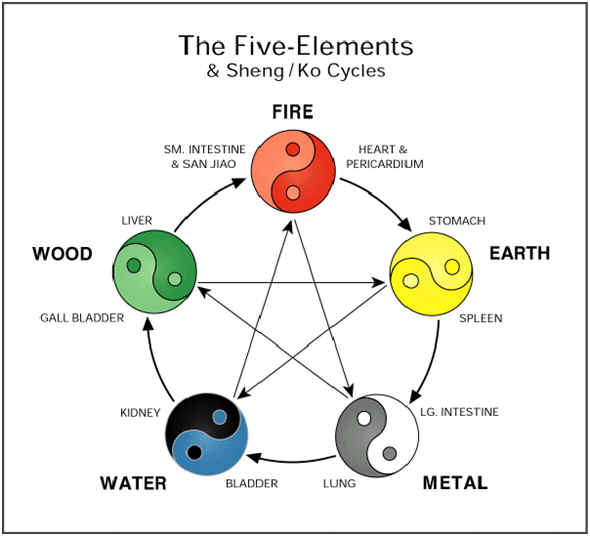
5 Element Principles
Basic Five Elements Emotion Chart
| Phase/Element | Metal | Water | Wood | Fire | Earth | |
| Organ | Lungs | Kidneys | Liver | Heart | Spleen | Triple Warmer |
| Sound | Sssssssssss | Chooooooo | Shhhhhhh | Haaaawww | Whoooooo | Heeeeeeee |
| Position of mouth, tongue and teeth | Teeth almost touching, tongue behind teeth | Lips round, like blowing out a candle | Lips puckered, sound rises from the Liver | Mouth relaxed, soft sigh from the Heart like "ahhh" | Lips round, open throat slightly tense, guttural sound | Lips thin, tongue almost touching palette, sound vibrates palette |
| Weather | Cool and dry | Cold and comfortable | Warm and moist | Hot and comfortable | Perfect Autumn day | Balanced |
| Color | Bright shiny white | Royal blue/black | Soft green | Bright red | Bright yellow | All colors blended |
| Distorted Emotion | Sadness Depression | Fear | Anger | Cruelty, Impatience, Hate | Worry, Anxiety (Past & Future) |
Little warmth, no harmony |
| Yin Balanced Emotion | Courage, Righteousness | Gentleness, Alertness | Kindness | Love, Respect, Patience | Fairness, Openness | Good "Contact" Feeling "Present" |
| Yang Balanced Emotion | Strength, Substantiality | Ambition, Willpower | Control, Decisiveness | Warmth, Vitality | Ability to be present, balanced, centered | Sense of direction, integration |
| Direction | West | North | East | South | Center - Earth | Empty Space |
| Animal | White Tiger | Blue/Black Deer or Turtle | Green Dragon | Red Chinese Pheasant | Golden Phoenix | |
| Planet | White Snow - Venus | Blue Snow - Mercury | Green Snow - Jupiter | Red Snow - Mars | Yellow Snow - Saturn | |
| Related Sense | Nose - Smelling | Ears - Hearing | Eyes - Seeing | Tongue - Tasting | Mouth - Swallowing | |
| Active Time | LU=3a.m - 5a.m. CO=5a.m. - 7a.m. |
KD=5p.m. - 7p.m. BL3p.m. - 5p.m. | LV=1a.m. - 3 a.m. GB=11p.m. - 1a.m | HT=11a.m. - 1p.m SI=1p.m. - 3p.m. | SP=9a.m. - 11a.m. ST=7a.m. - 9a.m. | TH=7p.m. - 9 p.m. |
| Active Season | Fall Sep 7 to Dec 7 |
Winter Dec 7 to Mar 6 |
Spring Mar 6 to Jun6 |
Summer June 6 to Sep 6 |
Indian Summer Aug 7 to Aug 25 |
|
| Energetic Movement | Contracting, Sinking, Letting go | Gathering, Absorbing, Nurturing | Generating, Rising, Expanding | Prospering, Radiating, Dispersing | Stabilizing, Grounding, Centering |
Metal
Metal is yin or feminine in character, its motion is inwards and its energy is
contracting. It is associated with the west and autumn, old age, the planet
Venus and the color white. The archetypal metals are silver and gold. Its Primal
Spirit is represented by a White Tiger.
The qualities associated with metal are unyieldingness, rigidity, persistence,
strength and determination. The metal person is controlling, ambitious, forceful
and set in their ways as metal is very strong; and they are self-reliant and
prefer to handle their problems alone. The metal person is also materialistic,
business oriented and good at organization and stability. However the metal
person can also appreciate luxury and enjoy the good things in life. Just as
metal can conduct electricity, the Metal person has strong impulses and
generative powers and can bring about changes and transformations for those who
come into contact with them. Metal is believed to govern the lungs, nose and
skin. The negative emotion associated with metal is grief, while the positive
emotion is courage.
Wood
Wood is yang or masculine in character, it is associated with springtime, the
east, the planet Jupiter, the colors brown or green, and with windy conditions.
Its Primal Spirit is represented by the Azure Dragon. In Chinese thought, Wood
attributes are considered to be strength and flexibility, as with bamboo. It is
also associated with qualities of warmth, generosity, co-operation and idealism.
The Wood person will be expansive, outgoing and socially conscious. The wood
element is one that seeks always to grow and expand. Wood heralds the beginning
of life, springtime and buds, sensuality and fecundity. Wood needs moisture to
thrive.
In Chinese medicine, wood is associated with negative feeling of anger, and
positive feelings of kindness and altruism. Organs associated with this element
are the liver (yin) and the gall bladder (yang), the eyes and the tendons.
Water
Water is yin or feminine in character, its energy is downward and its motion is
stillness and conserving. It is associated with the planet Mercury, the north,
winter and cold, darkness, night and the color blue-black. It is also associated
with the moon, which was believed to cause the dew to fall at night. It is also
believed to govern the kidneys, ears and bones. The negative emotion associated
with water is fear, while the positive emotion is calmness. Its Primal Spirit is
represented by the Black Tortoise.
In Chinese Taoist thought, water is representative of intelligence and wisdom,
flexibility, softness and pliancy; however, an over-abundance of the element is
said to cause difficulty in choosing something and sticking to it. In the same
way, Water can be fluid and weak, but can also wield great power when it floods
and overwhelms the land. In the birth and nurturing cycle, water spawns wood,
and is spawned by metal. In the conquest cycle, water overcomes fire, and in
turn is overcome by earth.
Fire
Fire is yang or masculine in character, its motion is upward and its energy is
expansive. It is associated with the planet Mars, summer, south, daylight and
heat and the color red. (Red is associated with extreme luck). It is also
believed to govern the heart, tongue, and pulse. Its negative emotion is hate,
while its positive emotion is joy. The Primal Spirit of fire is represented by
the Red Pheasant or Phoenix.
In Chinese thought Fire is associated with the qualities of dynamism, strength
and persistence; however, it is also connected to restlessness. The fire element
provides, warmth, enthusiasm and creativity, however an excess of it can bring
aggression, impatience and impulsive behavior. In the same way, fire provides
heat and warmth, however an excess can also burn. In the conquest cycle, fire
overcomes metal, and in turn is overcome by water. In the birth and nurturing
cycle, fire burns to earth, and is sparked by wood igniting.
Earth
Earth is a balance of yin and yang, the feminine and masculine together. Its
motion is inward and centering, and its energy is stabilizing and conserving. It
is associated with the color yellow and the planet Saturn, and it lies at the
center of the compass in the Chinese cosmos. It is associated with the turn of
each of the four seasons and with damp. It is believed to govern the spleen,
stomach, mouth and muscles. Its negative emotion is anxiety and its positive
emotion is empathy. Its Primal Spirit is represented by the Yellow Phoenix.
In Chinese thought Earth is associated with the qualities of patience,
thoughtfulness, practicality, hard work and stability. The earth element is also
nurturing and seeks to draw all things together with itself, in order to bring
harmony, rootedness and stability. Other attributes of the earth element include
ambition, stubbornness, responsibility and long-term planning. In pathology, the
earth can represent selfishness and self-centeredness. In the controlling cycle
earth controls water and is controlled by wood; while in the conducive cycle
earth is produced by fire, and in turn produces metal.