|
Healthy Living...
|
||||||||||||


|
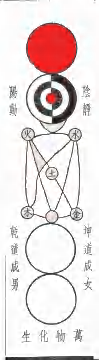
The Taiji (pinyin, "tài jí", the 'Supreme Ultimate') is a concept introduced in the Zhuang Zi and so has an early connection with Taoism. However, it also appears in the Xì Cí (Great Appendix) chapter of the Yì Jíng (Book of Changes). The Taiji is understood to be the highest conceivable principle, that from which existence flows. In contemporary terms, the Taiji is the infinite, essential, and fundamental principle of evolutionary change that actualizes all potential states of being through the self-organizing integration of complementary existential polarities. More simply, it is the co-substantial union of yin and yang, the two opposing qualities of all things. In order for 'hot' to exist, so must 'cold.' The existence of 'hot,' in fact, is wholly dependent on the existence of 'cold' and ultimately arises from it, just as the existence of 'cold' in turn arises from that of 'hot' and is wholly dependent thereupon. Note that as the highest conceivable principle, the Taiji is still superseded by the Tao (Dào) itself, the inconceivable essence of reality, which is by nature ineffable and beyond description. This 'ultimate reality' is that which cannot be named, although through conceptualizations such as the Taiji, the Tao can be approached. When Confucianism came to the fore again during the Song Dynasty, it synthesized aspects of Buddhism and Taoism, and drew them together using threads that traced back to the earliest metaphysical discussions in the appendices to the Book of Changes.
In Chinese concept, yin and yang are two opposing elements of the universe.
They are not two poles like good and evil, however; they are relative. For
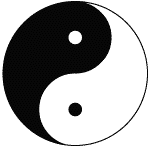
example, A modern example: Yin: the traffic light on the freeway (the stillness) Yin: the shady north side of the mountain, the south side of the river. Although while yin dominates femininity and yang masculinity, within the body of either sex, there are still traces of both elements. As a result, an imbalance of the yin-yang ratio can cause illness. This is not to say that everyone should have exactly half of each; every individual needs to find this balance depending on their own constitution, climate, season, occupation and even emotional environment. And, if in perfect health, the individual should be able to adapt to any inevitable changes. Together, the symbolic colors of yin and yang, black and white respectively, are combined into a circle that symbolizes Taoism for many: the Taijitu, often known as the Tai Chi symbol or the Pictogram of the Supreme Ultimate. Taoist philosophy is applied to metaphor and is used to describe thereby the dynamic complexities of the human body's organic processes in traditional Chinese medicine as well as the complexities of human personality (Chinese astrology), nothing in the universe is completely yin or completely yang. It is a basic Taoist tenet that yin and yang are artificial terms of convenience, depending ultimately upon the observer's perspective. There is always yin within yang, and yang within yin. This is symbolized in the yin and yang Tai Chi circle by the two smaller circles in either side: black within white and white within black. Another Taoist tenet is that one extreme will always change into its opposite, so that extreme yang turns into yin and vice versa. This is symbolized in the yin-yang symbol by the shape of the outer swooshes, which appear to be moving, one into the other. This principle has been extended into the physical realm of the martial arts, where yang and yin can directly represent the limits of balance in different directions; up and down, left and right, forward and back; and the physical properties of full and empty, hard and soft, active and receptive, etc. Over the centuries, the study of the interplay between these principles has led to the formulation and refinement of many different systems of self-defense across East Asia.
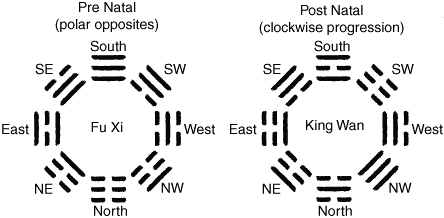
I Ching The I Ching (pinyin yì jing) is the oldest of the Chinese classic texts. Alternative romanizations of the name include I Jing, Yi Ching, Yi King. Translations of its name into English include the "Book of Changes" or more accurately "Classic of Change". It describes an ancient system of cosmology and philosophy which is at the heart of Chinese cultural beliefs. The philosophy centres around the ideas of balance through opposites and acceptance of change. The book is also known as Zhou Yi (zhou yì; alternately Chou I), the "Changes of Zhou", in ancient Chinese literature which indicates the book was based on work from Zhou Dynasty. The I Ching symbolism is embodied in a set of 64 abstract line arrangements called hexagrams (guà). These are each composed of six horizontal lines (yáo); each line is either Yang (unbroken, a solid line), or Yin (broken, an open line with a gap in the center). With six such lines stacked from bottom to top in each hexagram, there are 26 or sixty-four possible combinations and thus sixty-four hexagrams. Each hexagram is made of two trigrams. There are 8 possible trigrams. Each hexagram represents a state, a process, a change happening at the present moment. When an hexagram is casted, it is possible for one, many or all of the lines to be determined to be moving, ("old", or "instable") lines, i.e. their polarity is in the process of reversal and thus the meaning of the hexagram is completed and the "target" hexagram resulting from these changes is also considered. Note that because the lines in the hexagrams are traditionally determined by biased random-number generation procedures, the 64 hexagrams are not equiprobable if generated in these ways. There are a few formal arrangements of the trigrams and hexagrams with a traditional context. The ba gùa is a circular arrangement of the trigrams, traditionally printed on a mirror, or disk. Legend states that Fu Hsi found the ba gùa on the scales of a tortoise's back. More about this later. Components of Hexagrams In the following lists, the trigrams and hexagrams are represented using a common textual convention: horizontally from left to right, using '|' for yang and ':' for yin. Note, though, that the normal diagrammatic representation is to show the lines stacked vertically, from bottom to top (i.e. to visualize the actual trigrams or hexagrams, rotate the text counterclockwise 90°). There are eight possible trigrams (?? ba guà). ||| Force (qián) = heaven Traditionally it was believed that the principles of the I Ching originated with the legendary Fu Hsi. In this respect he is seen as an early culture hero, one of earliest legendary rulers of China (traditional dates 2852 BC-2738 BC), reputed to have had the trigrams (ba gùa) revealed to him supernaturally. Before the Zhou Dynasty, there was other literature on the "Change" philosophy, e.g. Lian Shan Yi (Lián Shan Yì) and Gui Cang Yi (Gui Cáng Yì). The philosophy heavily influenced the literature and government administration of the Zhou Dynasty. It was refined over time and I Ching was completed around the time of Han Wu Di (Hàn Wu Dì) during the Han Dynasty (circa 200 BC). In the past 50 years a "Modernist" history of the I Ching has been emerging, based on context criticism and research into Shang and Zhou dynasty oracle bones, as well as Zhou bronze inscriptions and other sources (see below). These reconstructions are dealt with in growing number of books, such as "The Mandate of Heaven: Hidden History in the I Ching", by S J Marshall, Columbia University Press, 2001, and Richard Rutt's "Zhouyi: The Book of Changes" from Curzon Press, 1996. Scholarly PhDs dealing with the new view of the Book of Changes include the dissertations by Richard Kunst and Edward Shaughnessy. These and other scholars have been helped immensely by the discovery in the 1970s by Chinese archaeologists of intact Han dynasty era tombs in Mawangdui near Changsha, Hunan province. One of the tombs contained more or less complete 2nd century BC texts of the I Ching, the Dao De Jing and other works, which are mostly similar yet in some ways diverge significantly from the "received" or traditional texts preserved by the chances of history. The tomb texts include additional commentaries on the I Ching, previously unknown, and apparently written as if they were meant to be attributed to Confucius. All of the Mawangdui texts are many centuries older than the earliest known attestations of the texts in question. When talking about the evolution therefore of the Book of Changes the Modernists contend that it is important to distinguish between the traditional history assigned to texts such as the I Ching (felt to be anachronistic by the Modernists), assignations in commentaries which have themselves been canonized over the centuries along with their subjects, and the more recent scholarly history aided by modern linguistic textual criticism and archaeology. Many feel that the two are not necessarily mutually exclusive, but, for instance, many Modernist scholars doubt the actual existence of Fuxi, think Confucius had nothing to do with the Book of Changes, and that the hexagrams came before the trigrams.
Integrity in Original Philosophy: "Schools of Thought"Before we examine some common misunderstandings of classical concepts let us address the notion of "different schools of thought", the primary alibi used to excuse and defend conflicting theories, philosophies and methodologies. As in any field, many professionals gravitate to and employ techniques with which they personally resonate. Physicists, for instance, sometimes engage exclusively in work with particle accelerators. Some others may be deeply interested in fluid dynamics or astrophysics or purely theoretical physics. This does not change the laws of physics. This does not produce different universes with different physical laws based on differing "schools of thought". I paraphrase Einstein: For laws of physics to be valid, they must be true for everyone in every part of the universe. The observations of individuals may vary depending on their point of view however, -- even though the observations are as valid as is their individual point of view -- this still does not change the laws of physics. Chinese medicine was and is not immune to this phenomenon. Ancient masters of Chinese medicine also engaged in this kind of "specialization". Tung's Acupuncture is a prime example. Tung, a fine acupuncturist in his own right, traveled throughout China recording the favorite techniques and "tricks" of the best doctors in the land. This resulted in a work entitled "Tung's Acupuncture", a compendium of classical and non-classical points and techniques for which he developed a separate nomenclature and numbering system in order to tie these "tricks" together in a coherent, understandable and usable system. The point is there is no such thing as Tung's Acupuncture. It should more properly be called "Chen's and Ching's and Ping's and Cheng's and Zhen's and Zhao's, (etc.) Acupuncture: A Book Of Techniques Based On A Complete Coherent System That Is Called Chinese Medicine, Compiled By Ching-chang Tung". Other examples are: Korean Hand Acupuncture, Craniopuncture, Auriculopuncture, the Japanese Systems, American Acupuncture, Constitutional Acupuncture, Energetic Layer Types, Trigger Point Therapy, "Various" Kinesiology, Micro-systems -- the list goes on and on as if there were a different "biology" for each system. There are not different biologies that respond to different systems. The message that must be taken here is -- Chinese medicine is a complete coherent, integral, interdependent and independent system of health care that must be understood within its own context, in whole, not in part, if it is to be mastered. It was born out of Daoist philosophy, which is at the heart of Chinese medicine and contains the original, guiding ideas that nurtured it into existence. Anything else is merely a fragment, no matter how elegant or seductive it may seem, it is only a specialty that, when studied in a vacuum, is merely a facet that will not reveal the jewel that produced it. As stated, since there are already many introductory books, our purpose in this work is not to present the entire field of Chinese medicine. In fact, we shall be at pains to avoid any redundancy. Instead, we will attempt to fill the gaps, supply the missing pieces, restore the guiding ideas and, where ever possible, correct misinformation when certainty about the error is assured.
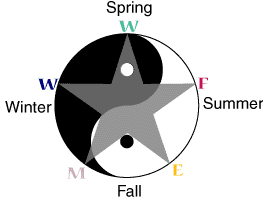
Symbols and ObjectsTo be faithful in the small is to be faithful in the large. What does this mean? It means if we are going to represent Chinese medicine faithfully and accurately, in order to gain and keep the respect the field rightfully deserves, we must look after the smallest details. We must be certain of what we say. We must be certain that there is consistency, continuity and integrity in the laws, rules, philosophy and even in the symbols we use to portray these ideas and concepts. (Lest you think I'm "nitpicking" consider what one might think of the other scientific disciplines if they were inconsistent with their symbols, say, physics equations or electronic schematics. c.f. Tran's quote at the introduction).Lets look at some examples: Nothing is more familiar, even to the non-student of Asian thought, than the Taijitu. Although he may not be able to name it he can certainly recognize it as familiar. But which of the following best represents the philosophical idea it is supposed to portray? Indeed, what is the philosophical idea it is supposed to portray? 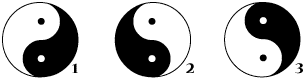 Figure 1 seems to represent a clockwise flowing motion with the yang portion ascending and the yin portion descending; Figure 2 is similar but implies an anti clockwise motion; in Figure 3 it appears yang is descending, yin is ascending and the flow is anti clockwise. The answers: firstly, none of them. Secondly, regarding what it does represent, let's digress slightly to the original meanings of yin and yang. Antedating any philosophical connotation to yin and yang were their original reference only to the shaded side and sunlit side of a hill or mountain. They later took on more metaphysical and emblematic usages in the hands of the Daoists. Since Daoist science is a product of the direct observation of the universe it didn't take long for these handy terms to provide symbols for all polar opposites. Neither was there any resulting contradiction to other natural phenomena or philosophical discussion of such, e.g. at its maximum, yin can transform into yang and yang into yin; simply watch the sun traverse from the sunny side to the shaded side, and at noon, they reverse. The notion that any qualitative symbol of Daoist science was "thought up" and these priests went scurrying about trying to find phenomena to fit them is decidedly a Western problem. For those thoroughly inculcated with the Greek/Western model this epistemological mode continues to be the stumbling block preventing any logical or useful grasp of Chinese medical science as a whole. The process of Western science looks something like this: Hypothesis/theory (guess) -> experiment (experience) -> Laws. (Quantitative) Whereas the process of Eastern science follows thusly: Natural phenomena (laws) -> experience (experiment) -> Thesis. (Qualitative) Both yield highly accurate information about totally different aspects of reality. The point is -- Eastern science never created terms in hopes of finding natural events to fit them to. Natural events were observed and fitted themselves quite "naturally" into qualitative standards of logically stringent categories (Yinyang and Wuxing). Five phase symbology (may we please drop the terms "theory" and "element") is a perfect example of this irritating tendency to "alter to make fit" or "rephrase to make sense". This is also why many writers and practitioners find the five phases so stubbornly resistant to Western "scientification" and so, frustrated, abandon it (except in the very few cases where it behaves physiologic quantification). In doing so they have thrown out the baby and kept the bath water. Five-phase science is not "too rigid" to be useful, the rigidity is in the minds of the cerebral stenotics that won't expand to include it, to understand it within its own context. To quote Vartan Gregorian quoting Sheraton "in looking for predigested ready-made answers, they have failed to undergo the fatigue of judging for themselves". One can read in the introductions of the various textbooks, the authors' stating the problem...
"Westerners, brought up in modern [read Western] scientific tradition, often have difficulty in grasping the concepts of Chinese medicine......Much of English literature, including that produced in China, omits the apparently irrational, while reformulating in inexact Western medical terminology much of what is acceptable..." They have fallen pray to their own caveat. Polarized in the Western mode, they omit the "apparently irrational" and state "inexactly" the remaining bits after a thorough cleaning with Occam's razor. We won't have that problem. We will present Chinese medicine whole and in the Daoist context -- the only way in which it can be understood. But nor can we rely on the books from China, as stated by the above authors, and as evidenced by the quote below in the definition of "Jing":
"Owing to this jing qi (whether it be generated right in the Kidneys themselves, or otherwise extended to these), Kidneys are somehow involved in, or even responsible for, the process of Reproduction. Even the marginally informed acupuncturist has an understanding of the tremendous responsibility Kidney energetics have with reproduction and mental states. Just as absurd as tossing out all or part of the five phases is the assumption one can practice only "five-element acupuncture" or "jing-luo" or "zangfu" acupuncture. These concepts simply don't make any sense. They come from the ubiquitous Western habit of reductionism i.e. cardiology, neurology etc. In the individual patient, one cannot treat an aspect in isolation of the whole. This even goes beyond the level of the individual. I am in no way making a metaphysical statement when I say the biota is contiguous with the cosmos... the flapping of a butterfly's wings will affect the weather of the world, the weather of the world inductively blends with the health of the biota. We are a "piece of the action".
Objects out of Symbols -- Matter out of EnergyPick your favorite translation of the Daotejing... verse 21.My 'cut-to-the-chase' translations: 1) Qualitative translation:
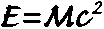
Xiang itself refers not only to the symbolic representation of an object but includes the object itself as well. Interesting term. Wu means matter, the real thing, substance. We can easily define separately the words: concepts, shapes, fields, functions and structures, energy and matter. But finding hard boundaries between them in physics and Chinese medicine is at best useless if at all possible. The notion that matter even exists (as such) is rapidly becoming unpopular in modern physics. I recently heard that quarks, for instance, can now spontaneously turn themselves into electrons and vice versa. Clinically there is no useful distinction between an organ, its field or Bao (energetic envelope), its structure, its channels, its sphere of influence or for that matter, its symbols, its xiang and wu.... Ancient Daoist philosophy: "Yin creates yang, yang activates yin" -- modern Einsteinian physics: "Matter tells space how to curve, space tells matter how to move".
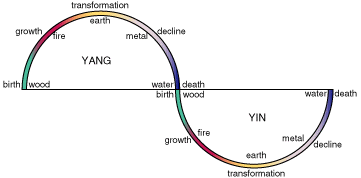
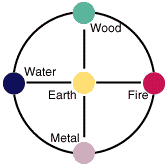
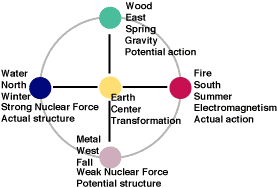
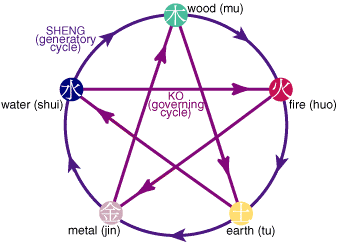
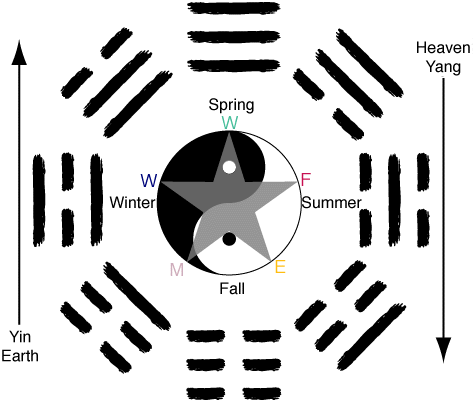
The Xiang and Wu of the Five Phases(Here is a diagram of the five phases and their meaning)(Here is another one for a comparison) Anything that comes into existence has a beginning, a middle and an end. A sentence, a paragraph, a book. Morning, noon, night. Fertilization, gestation, birth. Birth, maturation, death. To go from a "here" to a "there" (xing). One does not have to spend a long time on the planet to observe this immutable law. To expand this idea somewhat to better fit in the real world, a sine wave can quite accurately represent a qualitative schema of yang and yin coming into and going out of existence. Further, if we qualify every significant point of change in this wave: its beginning, its growth, its transformation, decline and end, the result is five points on each aspect of the wave (see below). We can also give each of these points ambiguous poetic emblems so they might be used to categorize and qualify similarly behaving phenomena, phenomena that show experientially that within their own categorical emblems: Wood, Fire, Earth, Metal and Water demonstrate resonant relationships. That is, all things which lend themselves to one of these five qualities also share a kinship of resonant relationship with all others in that category. (That's what all those Five-phase concordance charts are about -- differential diagnosis). |
||||
|
|